
Google Ads Suspension: What 120 Failed Cases Reveal
Google Ads suspensions are the fastest of the major platforms. Here is what 120 documented cases show about how those suspensions happen, why appeals often fail, and what keeps a suspension from becoming a shutdown.
Google Ads suspensions are the fastest of the major platforms.
The median observation window for Google cases in a dataset of 4,896 failed marketing campaigns is 22.1 days. The 25th percentile is 2.6 days. A quarter of documented Google suspensions unfolded within roughly two and a half days of the first signal.
That is faster than Meta (6.5 days at the 25th percentile) and faster than Reddit (4.4 days). Google enforces faster and with less warning than any other platform in the data.
Here is what 120 documented Google cases show about how those suspensions happen, why appeals often fail, and what separates the operators who recover from the ones who do not.
What Google enforcement actually is
Google enforces its advertising policies through three distinct mechanisms:
- Account Lifecycle. The account itself becomes unusable. Full account suspension, payment profile suspension, temporary holds on new campaigns.
- Rule Violation. A specific policy is enforced against you. Ad disapprovals, policy violations, prohibited business activities, circumventing systems flags.
- Concealment. Google's detection systems flag that you are hiding something. Mismatched business identities, mismatched payment data, cloaking, misrepresentation.
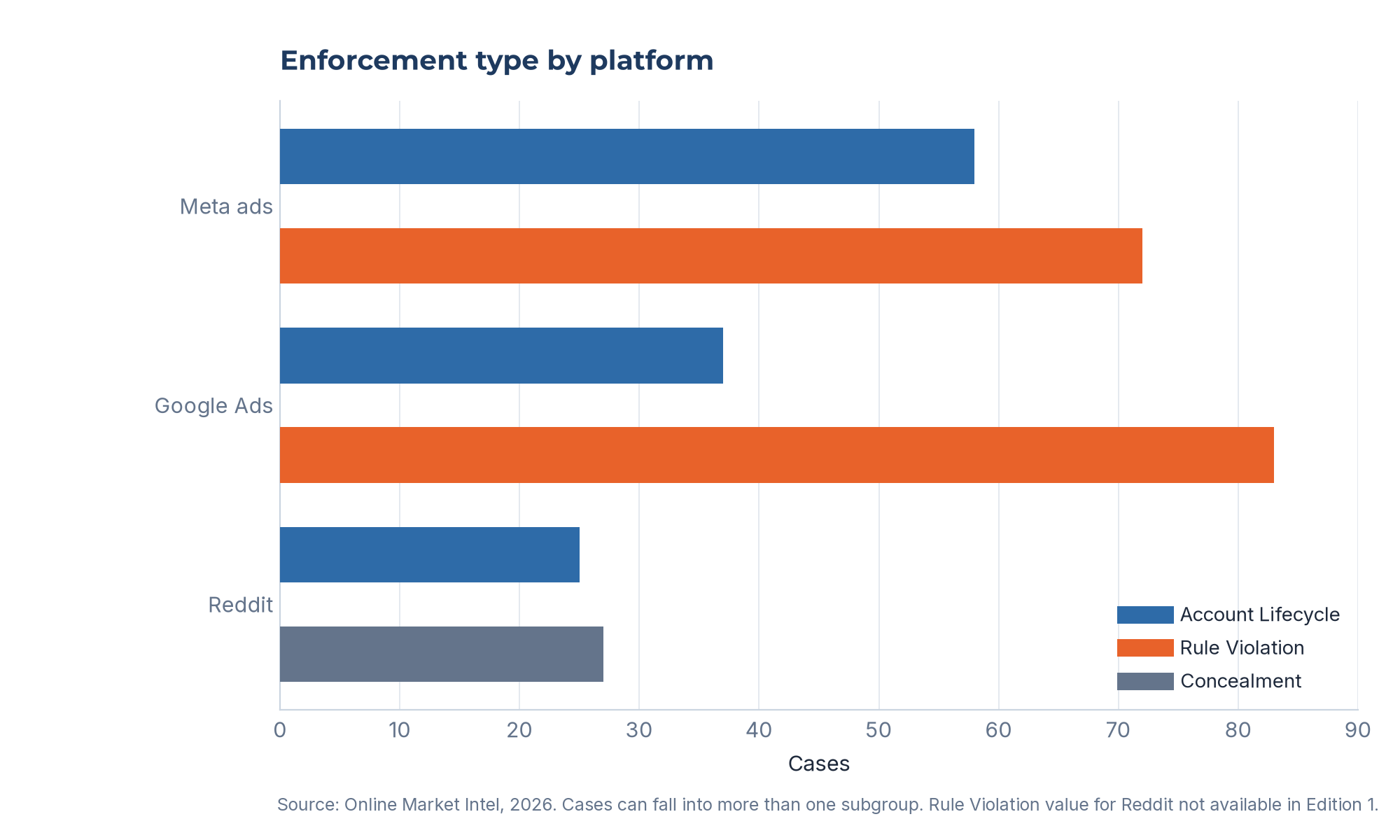
Rule violations lead here, and they are the enforcement type least likely to reverse. A lifecycle suspension at least starts from a process an operator can challenge. A rule violation tied to circumventing systems usually does not.
The distinction matters because the recovery path differs. A single ad disapproval is often reversible. A payment profile suspension is sometimes reversible. A circumventing systems flag is almost never reversible without a full account reset.
The two triggers that end most Google accounts
Two Rule Violation types appear repeatedly across the 120 cases.
The first is circumventing systems. Google's policy against circumventing its ad review and detection systems covers a wide range of behaviour: cloaking, redirects, mismatched domains, hidden text, attempting to bypass review with new accounts. When Google flags a case under this policy, it is usually not a single ad that is affected. It is the entire account, and often the payment profile behind it.
The second is suspicious payment activity. This trigger fires when Google's payment risk systems flag that the payment method, the billing country, or the account identity do not match what Google expects. It often appears alongside the circumventing systems flag, because both are triggered by the same underlying signal: mismatch between the operator's public presentation and their actual infrastructure.
How fast it happens
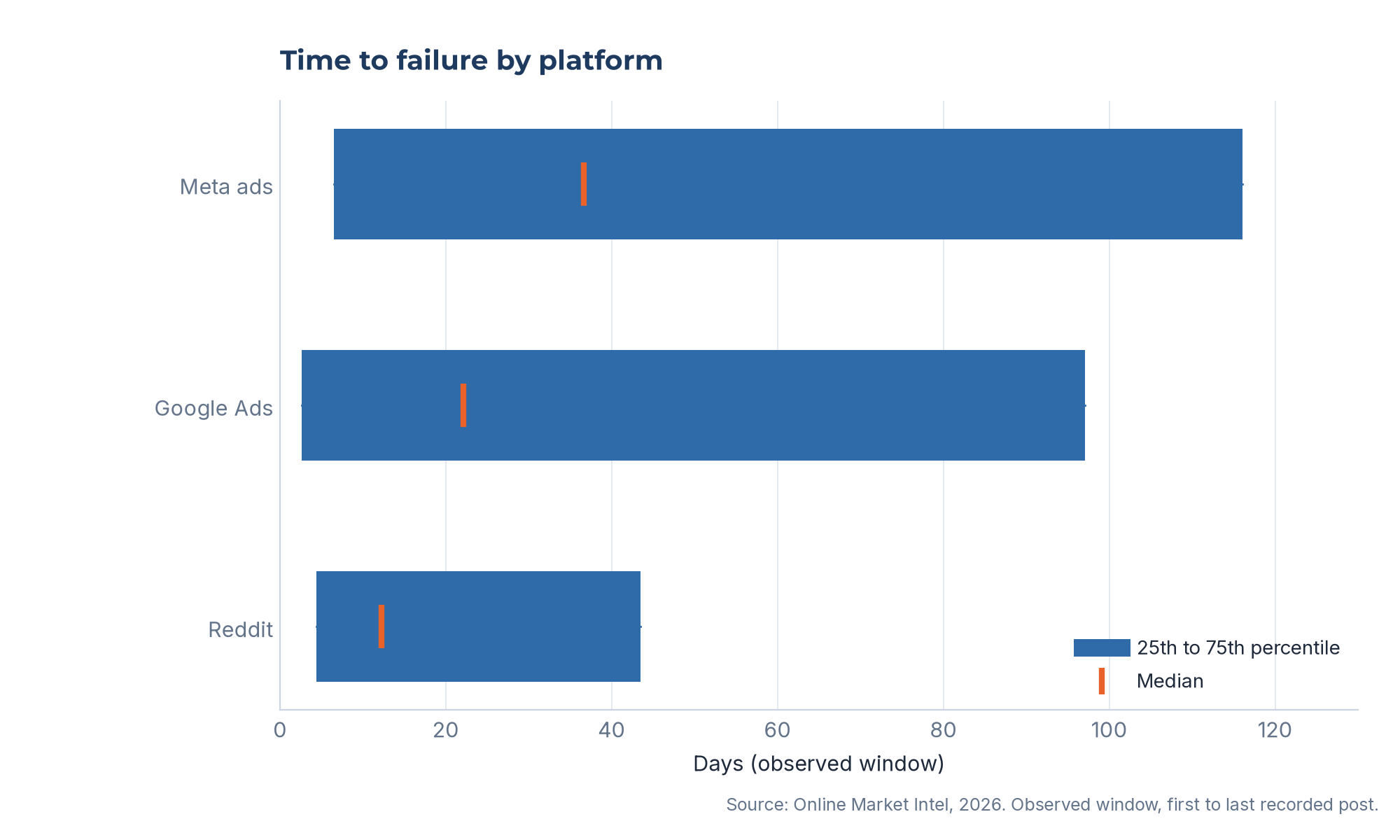
Google is the leftmost shape in the chart, and that position is the whole story: most of the action happens early. A suspension that survives its first days says little about how long the account stays down, but it rarely gets that far. The window to react is set at the start.
The practical implication is that Google suspensions are usually not a slow-burn problem. They are an event. The signal that matters is the first one, and the response window is short.
The pattern most operators miss
The single most common structural trigger across Google cases is not the campaign setup. It is the identity behind the account.
Google does not evaluate each ad in isolation. It evaluates the account as a unit: the personal Google account, the payment profile, the billing address, the domain history, the previous suspensions on any related account. When one of these signals is flagged, every subsequent account built on the same data inherits the flag.
That pattern shows up repeatedly in the data. The following case is representative.
One case, in detail
An operator ran search campaigns on Google Ads for over a year from a single account with an unremarkable history. The account had passed review multiple times. There had been no policy rejections and no payment issues.
The account was suspended for prohibited business activity. The operator appealed and, in parallel, opened new accounts with identical settings and the same payment data to keep campaigns running.
The replacement accounts were suspended within days. One was flagged for suspected payment circumvention. The others carried the same suspension reason as the original. The operator concluded that his own account data, not the campaign settings, had been flagged. Every subsequent account built on the same data inherited the suspension.
He reported no revenue from the replacement accounts and no clarity from Google about what specific signal had triggered the original flag.
What this case shows: Once the identity behind the account is marked, every successor account inherits the flag. Opening new accounts does not reset the flag. It confirms it.
What the operators who survive do differently
The dataset does not prove causation. But it shows a clear structural difference between failed and proven cases on the same platforms.
Among proven cases on Google, Meta, Reddit, Instagram, and other social platforms:
- 31.6% carried Ban/TOS risk at High
- 68.4% carried it at Medium or lower
Among failed cases on the same platforms:
- 69.5% carried Ban/TOS risk at High
- 30.5% carried it at Medium or lower
The gap is not a guarantee. It is a signal. Operators who built owned distribution, meaning email lists, self-hosted blogs, and direct audiences, carried significantly lower Ban/TOS risk in the same dataset. Operators whose entire distribution depended on a Google Ads account carried more.
The same pattern holds for Market/Algorithm risk:
- Proven cases: 28.5% at High
- Failed cases: 46.9% at High
The pattern is structural. It is not about being smarter with ad copy. It is about whether a single platform decision can shut down the entire business.
Google ads account suspended and the appeal problem
The data shows that appeals often fail, but not for the reasons most operators assume.
When the suspension reason is a single ad disapproval or a specific policy violation, appeals sometimes work. The signal is narrow and the fix is identifiable.
When the suspension reason is circumventing systems, suspicious payment activity, or a flagged identity, appeals rarely work. The signal is not narrow. Google is not asking the operator to fix one ad. It is signalling that the account itself is not trusted.
Operators who succeed at recovery after this kind of flag typically do three things. They separate the payment method and business identity completely from the flagged account. They start fresh with infrastructure that has no historical connection to the flag. And they wait, because Google's risk systems discount new accounts created immediately after a suspension.
That is not a guarantee of reinstatement. It is the only path with a non-zero success rate in the data.
What to check before you spend
Seven questions. Public versions; the full 21 live in the Failure Report.
Account setup
- Is your infrastructure independent enough that a single platform action cannot shut down the entire operation?
- Has the account been aged, warmed, and fully verified before any promotional post or ad spend?
Payment
- Is the payment method clean, matched to the account country, accepted by Google, and never used on a banned or restricted account?
Content and identity
- Is the offer allowed by Google's advertising policies without cloaking, misrepresentation, or circumventing systems patterns?
- Is the business identity consistent across the personal account, the payment profile, the billing address, and the verification documents? Same name, same address, same documents.
Redundancy
- Is the revenue plan diversified across at least two independent traffic or monetization sources?
Recovery
- Are tested backups and a recovery path ready for accounts, domains, pages, and payment methods before you spend on the primary setup?
The answers do not guarantee you will not be suspended. They determine whether the suspension kills your business or just slows it down.
The full picture
The Failure Report covers all 38 recurring patterns across four mechanisms, 11 documented cases in full, and the complete 21-question pre-launch checklist. It is built on the same 4,896 failed cases this article draws from.
Read the case brief for a free introduction. Get the failure report for the full analysis.
This analysis is part of our ongoing empirical failure study. View the aggregate Marketing Failure Statistics. Related reading: Facebook ad account bans and Reddit account suspensions. From the case notes: the mass AI content publishing failure, a Meta Ads sync glitch that burned $1,000, and Why We Created Online Market Intel.
Data as of September 2026, Edition 1. All cases drawn from publicly accessible online communities and anonymized. Reported figures are as described by operators, not independently verified. Google, Google Ads, and AdSense are trademarks of Google LLC.
Audit your account identity before you spend
This article draws on 120 Google cases inside a dataset of 4,896 failures. To see the full failure map, the four root mechanisms, and the 21-question pre-flight operational checklist, inspect the master report.