
Why We Created Online Market Intel
Digital marketing has an obsession with success stories. We decided to document where the capital actually disappears.
If you spend ten minutes on Twitter, LinkedIn, or YouTube, digital marketing looks like an effortless machine: teenage dropshippers making $50,000 in their first month, SEOs ranking niche sites in six weeks using automated AI prompts, and media buyers boasting 8x ROAS on TikTok Shop.
Almost all digital marketing literature suffers from a fatal structural flaw: extreme survivorship bias.
The industry only reports the outliers. The algorithms amplify the rare success stories because optimism sells courses, software subscriptions, and masterminds.
What nobody documents, and what no platform algorithm promotes, is the graveyard.
The graveyard nobody talks about
Behind every screenshot of a $100k revenue dashboard are hundreds of operators who did everything "by the book," yet saw their operations collapse within days.
Not because they lacked work ethic or creativity, but because the foundation beneath them was rotten:
- Their newly registered domain was quietly penalized due to a previous owner's spam history.
- Their ad campaigns suffered "delivery silence" because platform filters flagged their payment profile at the infrastructure level.
- Their accounts were banned within 72 hours because an anti-detect browser or shared proxy triggered an automated fraud heuristic.
- Their unit economics broke the moment real-world return rates and payment holds arrived.
When projects fail, operators rarely speak up. They quietly abandon the domain, absorb the loss of their ad spend, and blame themselves.
The industry treats these failures as isolated bad luck. We suspected they were structural patterns.
5,994 cases: looking at the real numbers
In early 2023, we stopped listening to marketing theory and started doing what financial analysts and post-mortem engineers do: we began collecting primary execution data.
Over more than three years (March 2023 to September 2026), we documented and structured 5,994 real-world operator runs from publicly accessible practitioner communities. We looked at paid traffic, organic search, social media automation, e-commerce, and affiliate arbitrage.
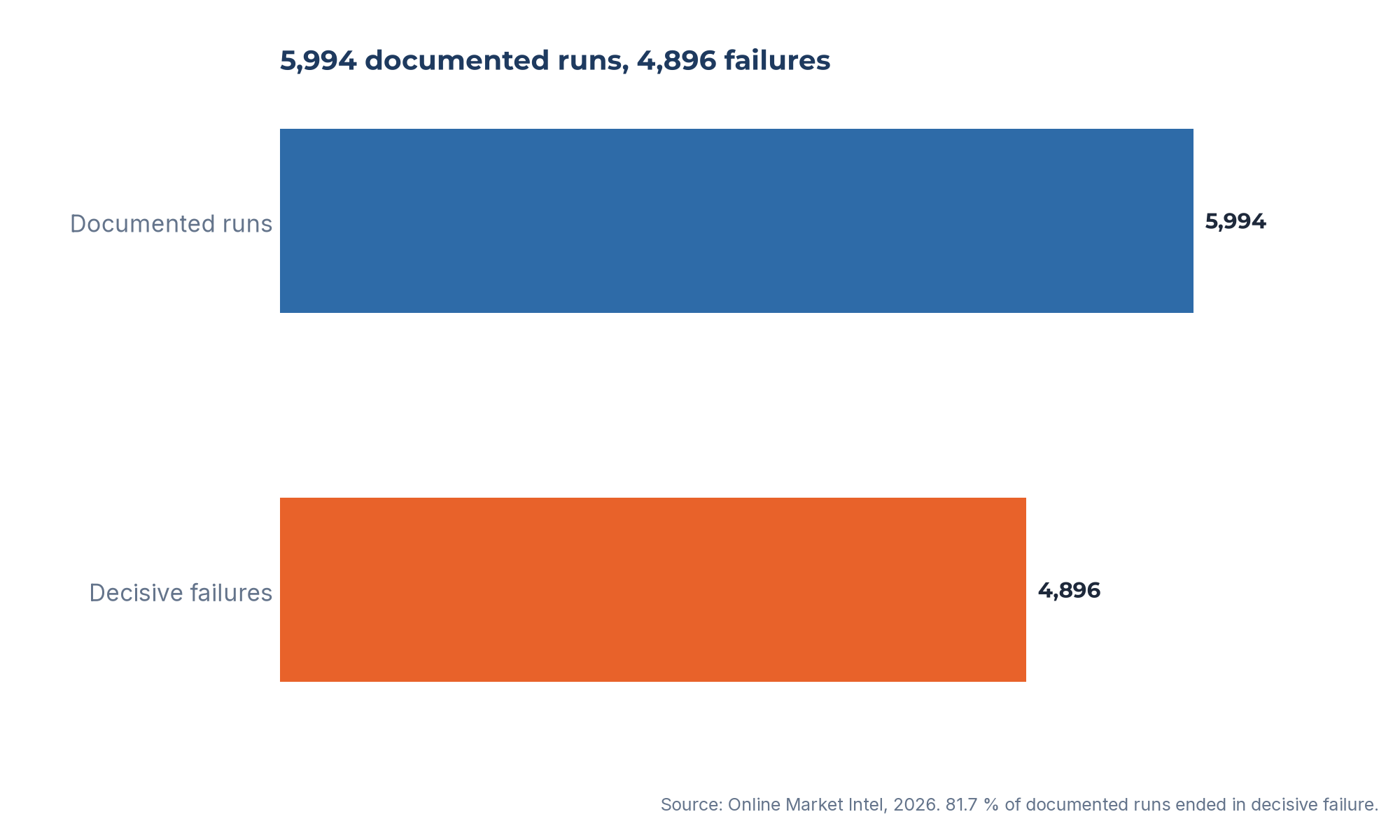
Most of the documented runs ended in decisive failure. The losses are not scattered across thousands of unrelated causes: they concentrate into just 38 recurring patterns and 4 core mechanisms, which is what makes them forecastable in the first place.
When you assemble thousands of failures into a structured dataset, the noise disappears and the mechanics become visible:
- Platform risk dominates: 60.1% of mapped failures are caused by platform enforcement (suspensions, payment freezes, bot filters), not because the audience rejected the product.
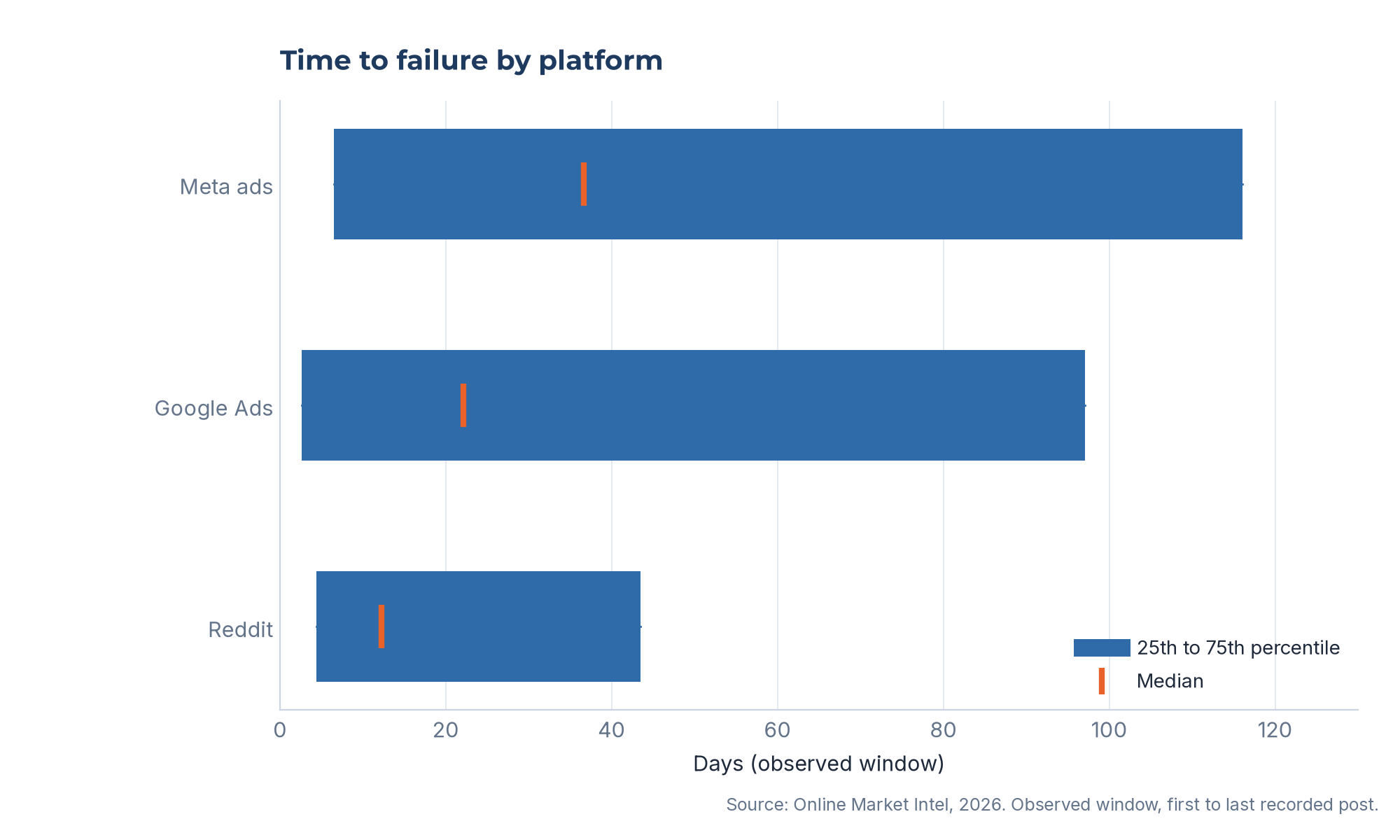
Failure is also fast, and it is platform-specific. The same enforcement mechanism that removes an account within days on one platform can take months on another, so a recovery playbook that works in one place does not transfer. How fast the loss lands is set by the platform, not by the operator.
What Online Market Intel is (and what it isn't)
We did not build Online Market Intel to sell you a coaching program, a secret traffic hack, or a lifestyle dream.
We built it to serve as an empirical intelligence layer for digital operators:
- We do not offer success recipes. We map failure modes so you know where capital is lost before you commit your own.
- We do not rely on opinions. Every analysis, risk map, and checklist is derived directly from documented primary executions.
- We treat marketing as a capital allocation problem. If an investment does not survive realistic platform scrutiny, payment holds, and unit economics, it is a gamble, not a business.
Our goal is simple: to provide the pre-flight instruments you need before you launch.
Where to start
If you are currently planning a campaign, launching a new domain, or scaling ad spend, do not rely on guru playbooks. Look at the post-mortem data first:
- Read the free 14-page Case Brief: an introductory breakdown of five real marketing executions, three proven and two failed. Open the Case Brief.
- Explore The Failure Report (38 pages): our comprehensive master research report analyzing all 4,896 failed cases, the 4 mechanisms, the Failure Risk Map, and the 21-question operational checklist. View the report.
Use the data before your next launch, not after your next loss.
The first deep analyses from the dataset cover Facebook ad account bans, Google Ads suspensions, and Reddit account suspensions.
Related: Case #4562, the mass AI content publishing failure and Case #5098, the $1,000 Meta Ads sync glitch.
Read the data before you launch
Five real cases in the free Case Brief, or the full 38-page Failure Report.